|
Spreading Patterns of Mobile Phone Viruses Center for Complex Network Research, Northeastern University |
PublicationsUnderstanding the spreading patterns of mobile phones viruses, P. Wang, M.C. González, C.A. Hidalgo and A.-L.Barabási, Science 324, 1071-1076 (2009). Media Science, Nature Physics, NSF, BBC, Scientific American, PhysOrg, ND, NEU |
Background
Materials Mobile viruses are little more than a nuisance today, but given our increased reliance on wireless communication, in the near future they could pose more risk than their PC based counterparts. Despite of the more than three hundred mobile viruses known so far, little is known about their spreading pattern, partly due to a lack of data on the communication and travel patterns of mobile phone users. Starting from the traffic and the communication pattern of six million mobile phone users, we model the vulnerability of mobile communications against potential virus outbreaks... |
Good introduction |
|
The
spread of mobile viruses is aided by two dominant communication protocols.
First, a Bluetooth virus can infect Bluetooth-activated phones within
a distance from 10 to 30m. Second, an MMS virus can send a copy of itself
to all mobile phones whose numbers are found in the infected phone’s
address book. |
Mobility Patterns Mobility data |
|
|
The cell phone dataset records provide
the location of each user during each call. Yet, the sampling is often
too sparse. To identify the hourly location we developed the following
procedure: we break each day into 24 hour long time intervals. If the
user calls during a specific hour period, we set user’s position
to the tower indicated by the dataset. |
| Mobility's tempal and spatial patterns | |
|
Given the sparseness of the calls, this leaves us with an incomplete location record. Therefore, we developed a methodology to identify the user’s likely location building on the results of human mobility patterns. We generate its location as following: (1) Decide if the user moves. (2) Extract a position seed. (3) Scaling and rotating user’s trajectory. (4) Check if new position is in the country. (5) Find the nearest tower. |
Methodology test We test our methodology by comparing the statistical properties of the simulated trajectories and those observed for the empirical data. In general, we find that our simulation does not introduce considerable biases in the statistical properties of the observed trajectories. Please see SOM for detail. |
Spreading Patterns Bluethooh and MMS viruses' spreading patterns |
|
|
The
spread of mobile viruses is aided by two dominant communication protocols.
First, a Bluetooth virus can infect Bluetooth-activated phones within
a distance from 10 to 30m. Second, an MMS virus can send a copy of itself
to all mobile phones whose numbers are found in the infected phone’s
address book. |
| Why no large-scale epidemic now, when there is? | |
|
The current lack of major mobile
virus outbreak can not be attributed to the absence of effective mobile
viruses, but it is mainly rooted in the fragmentation of the call graph.
Given, however, the rapid growth in the number of smartphones and the
increasing market share of a few OS, it is not unconcievable that the
phase transition point will be reached in the near future, raising the
possibility of major viral outbreaks. |
 |
The significance of our
research comes in its ability to explain why we have not observed a significant
MMS outbreak so far: currently the market share of the largest OS is less
than m~0.03, well under the predicted percolation transition
point mc~0.095. This, naturally, represents only an approximation.
For example, if we increase the observational period from a few days to
three months, mc decreases to mc=0.051. The question
is, what the real value of mc, and how does it compare to the
market share of the largest OS? |
| Spatial Spreading Patterns | |
 |
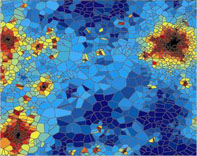
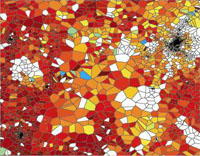
Bluetooth and MMS viruses
differ in their spatial spreading patterns: a Bluetooth virus follows
a wave like pattern, infecting predominantly users in the vicinity of
the virus’s release point, while an MMS virus follows a more delocalized
pattern, given that the users’ address book often contains phone
numbers of far away users. We also made additional simulation to compare
the spatial spreading pattern of a hybrid virus to the spreading pattern
defined by Bluetooth and MMS viruses confirming that the spatial spreading
pattern defined by hybrid viruses represents a combination of the spreading
patterns defined by Bluetooth and MMS viruses. |
| Movies | ||
BLUETOOTH VIRUS |
MMS VIRUS |
SPREAD METHODS |
Virus Infection Movies |